
Poker is more than just a card game; it is a complex blend of psychology, probability, and strategy. Every decision you make at the table is influenced by your understanding of poker hands, how they rank against each other, and the mathematical likelihood of being dealt each combination. To play at a competitive level, you must master both poker hand rankings and probabilities, understanding not only what beats what, but also how often certain hands appear and how to act on that information.
In this detailed guide, we’ll explore the structure of poker hands, the mathematical underpinnings that dictate their strength, and the real-world implications of hand probabilities on gameplay. Whether you’re analyzing preflop odds or calculating the chance of a straight draw completing, mastering the logic of poker hands will elevate your decision-making and overall win rate.
The topic of understanding poker hands: rankings and probabilities serves as the foundation of advanced poker theory and is essential for anyone aiming to excel in the game strategically rather than relying on intuition.
The Hierarchy of Poker Hands
Before diving into probabilities, it’s crucial to understand the standard hierarchy of poker hands. In most poker variants like Texas Hold’em and Omaha, the rankings remain the same. Knowing these rankings by heart allows players to evaluate situations instantly and make accurate decisions under pressure.
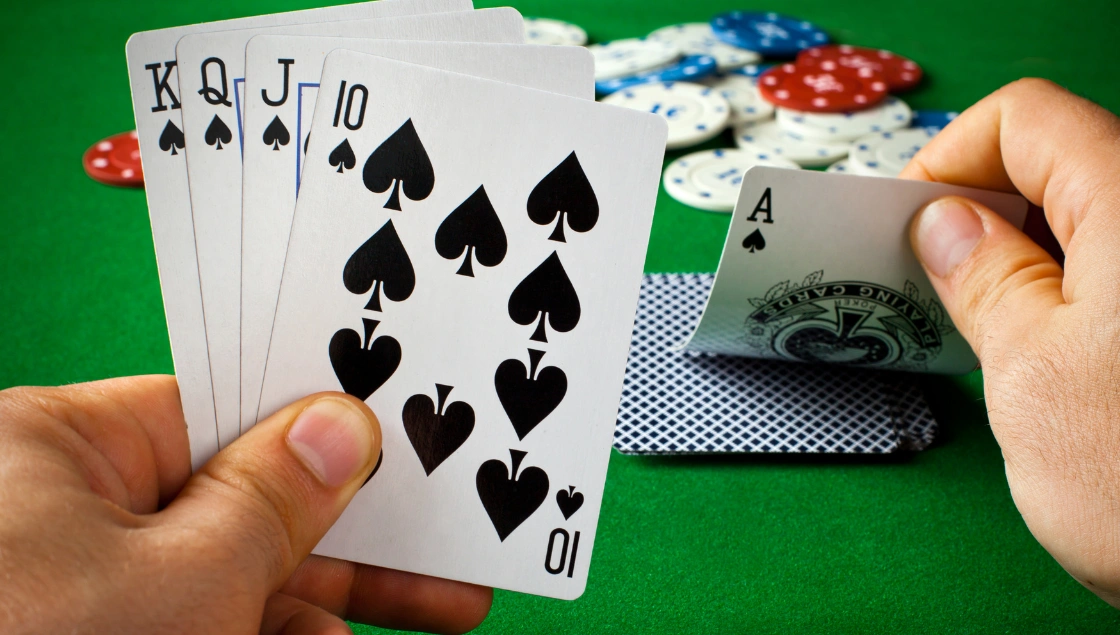
Royal Flush
- Description: The rarest and strongest possible hand in poker, consisting of A♠, K♠, Q♠, J♠, and 10♠.
- Probability: Approximately 1 in 649,740 hands.
- Insight: While nearly impossible to achieve, this hand symbolizes absolute dominance at the table. Its rarity means it’s statistically insignificant in long-term play, but its presence defines the top of the hierarchy.
Straight Flush
- Description: Five consecutive cards of the same suit, such as 7♦, 8♦, 9♦, 10♦, J♦.
- Probability: 1 in 72,193 hands.
- Insight: Slightly more attainable than a Royal Flush, but still incredibly rare. Recognizing potential straight flush draws during play can influence betting aggression.
Four of a Kind
- Description: Four cards of identical rank, such as 9♠, 9♦, 9♣, 9♥, plus one side card.
- Probability: 1 in 4,165 hands.
- Insight: Dominant in almost any scenario. The real skill lies in disguising this hand, as aggressive betting may scare off opponents before maximizing value.
Full House
- Description: Three cards of one rank and two of another, such as K♣, K♠, K♦, 3♣, 3♥.
- Probability: 1 in 693 hands.
- Insight: A strong but vulnerable hand, especially when potential four-of-a-kind or higher full houses exist. Reading board textures is key when holding this hand.
Flush
- Description: Five non-sequential cards of the same suit. Example: A♦, 9♦, 6♦, 4♦, 2♦.
- Probability: 1 in 508 hands.
- Insight: The flush is often a game-deciding hand, especially in multiway pots. However, always evaluate the strength of your highest card within the flush, as stronger flushes can dominate weaker ones.
Straight
- Description: Five sequential cards of mixed suits. Example: 5♠, 6♥, 7♣, 8♣, 9♦.
- Probability: 1 in 254 hands.
- Insight: While powerful, straights can be easily countered by flushes or full houses. Timing and position are critical when playing this hand aggressively.
Three of a Kind
- Description: Three cards of the same rank and two unrelated cards. Example: Q♠, Q♥, Q♦, 8♠, 3♦.
- Probability: 1 in 46.3 hands.
- Insight: Often disguised and profitable when hidden, particularly when formed from the board (trips) instead of being held in hand (a set).
Two Pair
- Description: Two different pairs and one kicker. Example: 10♠, 10♥, 6♠, 6♦, 4♣.
- Probability: 1 in 21 hands.
- Insight: A moderate hand that depends heavily on board texture. Vulnerable to higher pairs and full houses, yet valuable for value extraction in casual pots.
One Pair
- Description: Two cards of the same rank and three unrelated cards. Example: J♦, J♠, 8♦, 4♥, 2♣.
- Probability: 1 in 2.36 hands.
- Insight: The most common winning hand at low stakes, yet also the most overvalued by beginners. Context, kicker strength, and reading opponents’ tendencies are critical.
High Card
- Description: When no combination is formed, the highest card wins. Example: A♣, 9♦, 7♠, 5♣, 3♥.
- Probability: 1 in 1.99 hands.
- Insight: Common but weak; valuable primarily as a bluffing tool or tie-breaker in passive games.
Probabilities in Poker: The Mathematics of Luck
Poker is a game of incomplete information where probability provides structure amidst uncertainty. Understanding the likelihood of each hand helps guide decisions like whether to call, fold, or raise.
The Combinatorial Logic of Poker Hands
There are 2,598,960 possible five-card combinations in a standard 52-card deck. Each hand ranking represents a subset of this total. The rarity of a hand is what defines its power.
For example:
- Full House combinations: 3,744
- Flush combinations: 5,108
- Straight combinations: 10,200
This scarcity hierarchy ensures that stronger hands occur less frequently, balancing the game’s risk-reward dynamic.
Drawing Odds and Pot Equity
While the probability of being dealt a hand matters, in-game probabilities—like drawing to a straight or flush—often define success.
Flush draw probability:
If you have four suited cards after the flop, there are 9 remaining cards of that suit. The chance of hitting the flush by the river is about 35%.
Open-ended straight draw probability:
With eight possible cards completing your straight, your chance of hitting it by the river is roughly 31.5%.
Gutshot straight draw probability:
Only four possible cards complete this, giving about a 16.5% chance by the river.
Advanced players use pot odds and expected value (EV) to determine whether continuing with a draw is mathematically justified based on potential reward versus risk.
Probability of Premium Starting Hands (Texas Hold’em)
Starting hands form the foundation of strategy in Texas Hold’em. Below are key probabilities:
- Pocket Aces (AA): 0.45%
- Pocket Kings (KK): 0.45%
- Any Pocket Pair: 5.88%
- Suited Connectors (e.g., 8♠9♠): 3.92%
- Two High Cards (e.g., AK, AQ): 2.1%
Recognizing these odds reinforces disciplined play, avoiding overvaluation of mediocre hands.
The Relationship Between Rankings and Probabilities
Hand rankings directly reflect probability. The rarer the combination, the higher it ranks. However, skill lies in contextual interpretation. A pair might be weak on one board but powerful on another. Therefore, understanding relative strength is as important as absolute ranking.
For instance:
- A top pair on a dry board (no draws possible) can be strong.
- The same pair on a wet board (possible straights or flushes) may lose value.
- A set (three of a kind made with a pocket pair) has high winning equity but can be crushed by higher full houses or straights.
Successful players combine probability with psychological insight to gauge when their mathematically strong hand is actually vulnerable.
Strategic Implications of Probability Knowledge
Understanding probabilities allows players to act rationally under uncertainty.
- Preflop strategy: Choosing hands with strong starting probabilities minimizes long-term losses.
- Postflop calculation: Knowing draw odds helps determine when to chase or fold.
- Bluff timing: Understanding how rare certain hands are helps in representing them credibly during bluffs.
Players who internalize mathematical expectations outperform those relying purely on intuition.
Real-World Application: Balancing Math and Intuition
In practice, poker is not purely mathematical. Emotional intelligence, risk management, and reading human behavior matter just as much. The best players blend analytical skill with psychological awareness.
For example:
- A player may fold a mathematically superior hand if they sense strength in an opponent.
- Conversely, understanding that the probability of an opponent holding a better hand is low can justify bold aggression.
The fusion of probability awareness and psychological acuity defines professional-level play.
Practical Tips for Mastering Poker Hand Probabilities
- Memorize the hierarchy: Automatic recognition prevents mistakes under pressure.
- Use odds tables: Reference common draw odds until they become second nature.
- Think in ranges: Instead of fixating on one hand, estimate the likelihood of what your opponent could have.
- Leverage position: Late position allows more informed decisions about pot odds and implied value.
- Stay disciplined: Understanding probability means folding when the math doesn’t justify chasing losses.
FAQ
How often should I expect to get a premium hand like pocket aces?
Pocket aces appear once every 221 hands on average, or about 0.45% of the time. Recognizing their rarity reinforces the need to extract maximum value when you do get them.
Do probabilities change in online poker compared to live play?
No. Assuming fair play, both environments use the same 52-card probabilities. What differs is the speed of play, allowing more hands per hour online.
How important is understanding hand probability in bluffing?
Crucial. Knowing how unlikely it is for opponents to have certain combinations helps you represent strong hands credibly and choose effective bluff spots.
What is the biggest mistake players make with probabilities?
Overestimating draw odds or misunderstanding implied odds. Many players chase unlikely draws that don’t justify the risk compared to potential payout.
Can memorizing probabilities guarantee success?
No, but it significantly improves decision quality. Success in poker combines mathematics, psychology, and discipline. Probabilities guide logic; strategy and self-control ensure profit.
Understanding poker hands: rankings and probabilities turns the game from guesswork into a structured discipline rooted in math and logic. Once you internalize how often certain hands appear and how they interact, your choices become sharper, your risk management improves, and your long-term results align closer to statistical expectation rather than luck.